Turning Store Data into Measurable Business Performance
How wireless sensor integration with BACnet-enabled systems helps retailers reduce spoilage, lower energy costs, and standardize operations at scale
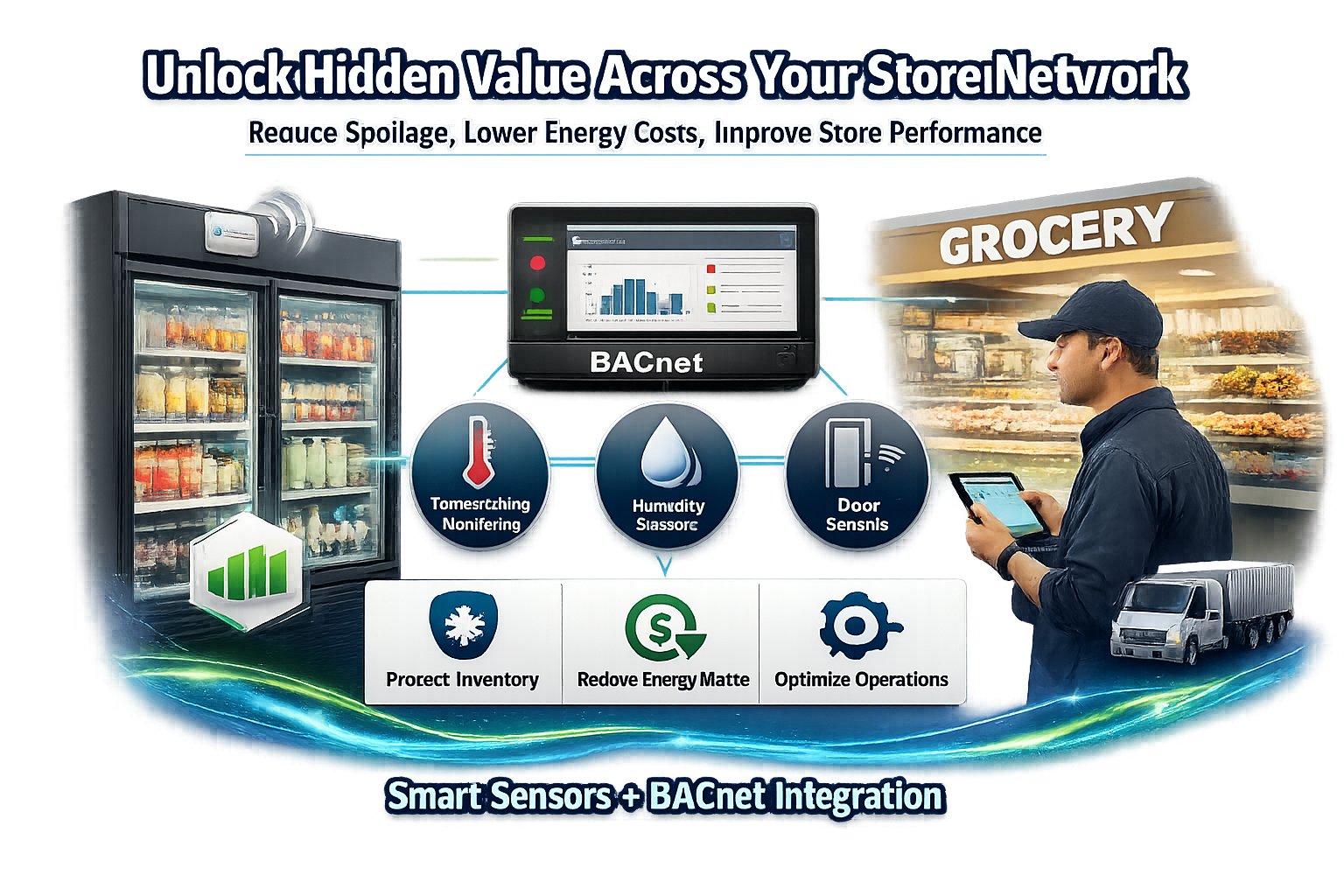
Unlock Hidden Value Across Your Store Network
In today’s retail environment, operational performance depends more than efficient buildings—it depends on protecting inventory, controlling energy costs, and maintaining consistency across every location. In this use case, a nationwide pharmacy and grocery chain enhanced its existing store infrastructure by integrating wireless sensors into a BACnet-enabled control system, unlocking new visibility into refrigeration performance, environmental conditions, and in-store operations. Without disrupting daily business or requiring costly retrofits, the organization transformed fragmented data into actionable insight, reducing product loss, improving energy efficiency, and enabling faster, more consistent decision-making across its entire store network.
Overview
Nationwide Pharmacy / Grocery Chain: Protecting Refrigerated Inventory, Reducing Energy Waste, and Improving Store Operations
A national chain with hundreds of stores wants better control over refrigerated cases, walk-ins, front-of-store comfort, and environmental conditions. The company’s problem is not just “building efficiency.” It is business performance: reducing product loss, avoiding compliance risk, lowering energy spend, and improving store consistency across locations. In grocery and supermarket environments, refrigeration is often the single largest electricity user, accounting for roughly 40% to 60% of store electricity consumption. In an industry with thin margins, EPA-cited research notes that a 10% reduction in energy costs can be equivalent to a 16% increase in net profit margins for the average supermarket.
The challenge
Most chains have partial visibility at best. They may know when a major cooler fails, but they often lack granular data on cooler temperature drift, door-open duration, humidity, condensation risk, back-room walk-ins, and store-level comfort conditions. That means problems are discovered late, after spoilage, customer complaints, frost buildup, higher compressor load, or wasted labor. Research from DOE and EPA reinforces that refrigeration is such a large share of store energy use that even modest operational improvements can materially affect operating performance.
The solution
The chain deploys a wireless sensor layer across stores, including cooler and freezer temperature sensors, door open/closed sensors, humidity sensors near refrigerated cases, and ambient store temperature sensors. These devices connect through a gateway into the store’s building controller, where a BACnet-enabled integration feeds the building platform. BACnet’s value here is interoperability: it allows data from networked equipment and control devices to be centralized in a vendor-independent way across building automation applications. That makes it practical to bring refrigeration-adjacent data, HVAC behavior, alarm logic, and store conditions into one operational view instead of leaving them siloed. Whether you own the location or its rented; wireless sensor deployment is a simple way to gain insights without disrupting normal business.
How business value is created
Instead of using sensors only for alarm notification, the retailer uses them to drive operating decisions. Door sensors show which cases are routinely left open too long. Humidity data identifies locations where condensation, frost, anti-sweat heater use, and refrigeration load are likely increasing costs. Ambient store temperature data helps coordinate store comfort and refrigeration performance rather than treating them separately. Research shows store humidity has a measurable effect on refrigerated case energy use: one analysis found that a 5% reduction in store relative humidity reduced display-case refrigeration load by about 9.25% and lowered total store energy use as well. Earlier work similarly found meaningful reductions in display-case operating costs and energy use as humidity is better controlled.
Before
Stores relied on periodic checks, disconnected alarms, and limited visibility into cooler performance, door-open behavior, and humidity conditions. Refrigeration issues were often discovered after inventory was already at risk, while district teams lacked a standard way to compare conditions across locations.
After
Business impacts
The retailer improved product protection, reduced avoidable energy waste, and created a repeatable operating model for store-level visibility. In practice, the value came from turning building and refrigeration data into business actions: protect inventory, reduce utility spend, prioritize maintenance, and standardize execution across the fleet. That aligns with broader analyst and market research showing continued investment growth in IoT for retail and in temperature/humidity monitoring across the food value chain. ABI Research projects food cold-chain track-and-trace revenues to exceed $7 billion by 2032, and Technavio projects strong growth in IoT retail applications, reflecting sustained demand for data-driven operational systems.
Protect sales
Reduce energy waste
Reduce energy waste in an environment where refrigeration may represent 40% to 60% of store electricity use.
Improve margins
Standardize operations
Wireless sensing plus BACnet-enabled integration helps retailers turn refrigeration, environmental, and store-condition data into measurable business outcomes: less spoilage, lower energy costs, faster issue response, and more consistent execution across every location.
Ultimately, this approach shows that improving retail performance does not require replacing existing systems, but enhancing them with better data. By extending visibility into refrigeration, environmental conditions, and store operations through wireless sensor integration, retailers can shift from reactive issue management to proactive, data-driven decision-making.
As energy costs rise, compliance pressures increase, and margins remain tight, expanding the data layer across store environments becomes one of the most practical and scalable ways to protect inventory, reduce waste, and drive consistent performance across every location.
Reference Data:
- https://www.epa.gov/sites/default/files/2016-03/documents/2015-03.pdf
- https://www.energy.gov/eere/buildings/downloads/case-study-transcritical-carbon-dioxide-supermarket-refrigeration-systems
- https://bacnetinternational.org/
- https://ui.adsabs.harvard.edu/abs/2012ApEn…98…11B/abstract
- https://www.sciencedirect.com/science/article/pii/S2772502225001295
- https://www.prnewswire.com/news-releases/food-cold-chain-track-and-trace-technology-revenues-set-to-exceed-us7-billion-amid-growing-regulatory-scrutiny-on-food-supply-chains-302111152.html