The Role of Cellular Connectivity in Modern Smart Cities
Connecting Smart Cities with Cellular Technology
When people think about smart cities, they often picture the visible technology: EV charging stations, smart parking systems, digital signage, connected public transport, and environmental monitoring networks.
What is less visible, but arguably more important, is the infrastructure connecting these systems together.
A smart city is not simply a collection of connected devices. It is an ecosystem of sensors, assets, applications, operators, and citizens continuously exchanging information. Every parking update, air-quality reading, charging session, traffic alert, and maintenance notification depends on reliable connectivity moving data between the physical and digital worlds.
Without that connectivity layer, smart-city services cannot deliver the efficiency, visibility, and citizen experiences they promise.
The Growing Complexity of Urban Infrastructure
Cities are becoming increasingly connected. A single city district may contain:
- Smart parking sensors
- EV charging infrastructure
- Public transportation systems
- Connected street lighting
- Digital information displays
- Air-quality and environmental sensors
- Waste-management monitoring
- Public safety systems
- Connected vending and payment terminals
- Smart building management systems
Each deployment may involve hundreds or thousands of endpoints distributed across a wide geographic area.

Unlike equipment in traditional IT environments, smart-city assets are often deployed:
- Outdoors
- In difficult-to-access locations
- Across multiple jurisdictions
- Without local network infrastructure
- In areas where wired connectivity is impractical
This creates a significant connectivity challenge.
Why Connectivity Is Often Overlooked
Many smart-city projects begin with the application.
The discussion typically focuses on improving parking utilisation, reducing energy consumption, monitoring environmental conditions, or enhancing traffic flow.
Connectivity is sometimes treated as an implementation detail rather than a strategic design decision.
However, once projects move beyond pilot deployments, connectivity often becomes one of the most important considerations.
Questions quickly emerge:
How will devices communicate across a city?
- How will systems scale from hundreds to thousands of endpoints?
- How will assets be managed remotely?
- What happens when networks change?
- How will new devices be provisioned and maintained over time?
- How can deployment teams reduce installation complexity?
he answers often determine whether a project can successfully scale.

Why Choose Cellular Connectivity for Smart Cities?
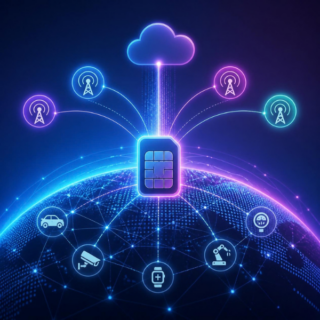
Cellular connectivity is particularly well suited to smart-city infrastructure because it combines wide-area coverage, rapid deployment, secure direct-to-cloud communications, and remote management without requiring cities or solution providers to build a dedicated wired network at every location. It can connect individual assets directly or provide resilient backhaul for gateways aggregating data from technologies such as LoRaWAN. This flexibility supports deployments ranging from a single connected product to thousands of distributed assets.
Wide-Area Coverage
Municipal infrastructure is rarely concentrated in a single location.
Parking systems, charging stations, transportation assets, environmental sensors, and utility equipment may be distributed across entire cities, regions, or countries. Cellular networks already provide extensive coverage, enabling organisations to connect assets without building or maintaining their own communications infrastructure.
Rapid Deployment
Installing wired communications can be expensive, disruptive, and time-consuming. Cellular-enabled devices can often be deployed more quickly, helping projects move from pilot phases into operational environments faster.
Remote Management
Many smart-city assets are located in areas where frequent on-site access is impractical. Cellular connectivity supports remote visibility, monitoring, troubleshooting, and maintenance, helping reduce operational costs and downtime.
Scalability
As smart-city projects expand, connectivity solutions must support long-term growth. Cellular technologies allow organisations to add new devices and services without redesigning the entire communications architecture.
Resilience and Flexible Network Design
Cellular can serve as the primary connection for assets without access to fixed infrastructure or as a backup path when wired services are interrupted. With a choice of public, private, and low-power cellular technologies, deployment teams can match connectivity to the coverage, bandwidth, power, cost, and lifecycle requirements of each application.
Cellular and LoRaWAN: Better Together
For many smart-city deployments, the question is not cellular or LoRaWAN.
The most effective solution is often a combination of both.
LoRaWAN provides an efficient way to connect large numbers of low-power sensors, while cellular connectivity provides a reliable backhaul path that transports data from gateways to cloud applications and operational systems.
Examples include:
- Smart parking networks
- Environmental monitoring systems
- Flood detection
- Smart waste management
- Building monitoring
- Utility metering
In these deployments, LoRaWAN and cellular technology work together to create a scalable, flexible connectivity architecture.
Supporting Smart Mobility Infrastructure
Smart mobility initiatives illustrate why connectivity matters. From EV charging stations and intelligent transport systems to parking management, fleet operations and logistics hubs, modern transport ecosystems increasingly depend on connected infrastructure. Traffic monitoring and public transit services also rely on operational data that must be collected, analysed and acted upon.
Reliable cellular connectivity helps keep these distributed assets and services connected while supporting ongoing asset management and lifecycle planning.
From Embedded Design to City-Wide Deployment
MultiTech supports smart-city connectivity at multiple points in the architecture – from cellular connectivity embedded directly into an OEM’s equipment to managed routers and gateways deployed across city infrastructure. This gives product developers, solution providers, and operators a more practical path from initial design and evaluation to scalable deployment and long-term management.
Reliable cellular connectivity helps keep these distributed assets and services connected while supporting ongoing asset management and lifecycle planning.
- Embedded Cellular Modems: MultiTech’s ready-to-integrate embedded modems help product developers add cellular communications with less engineering and certification effort.
- Industrial Cellular Routers: MultiConnect rCell routers provide secure, remotely manageable connectivity for distributed assets, with options supporting network failover, Wi-Fi, edge intelligence, and cloud-based device management. The portfolio includes the rCell 300 and rCell 500 Series for current and evolving deployment requirements.
- Cellular and LoRaWAN Gateways: MultiTech Conduit and Conduit AP gateways connect LoRaWAN devices and sensor networks to Ethernet, cellular, cloud, and operational platforms, providing a flexible foundation for city-wide sensing and monitoring.


Designing for the Future
Connectivity decisions made during the planning stage can have long-term implications for smart-city projects. Organisations should consider:

- Coverage requirements
- Scalability objectives
- Device lifecycle management
- Remote provisioning capabilities
- Security requirements
- Future network flexibility
- Multi-network support
- Integration with cloud platforms and applications
The strongest smart-city deployments are designed with connectivity as a foundational element rather than an afterthought.
Connecting the Future of Smart Cities.
Smart cities are often discussed in terms of applications and outcomes: safer streets, cleaner environments, more efficient transportation, and better citizen experiences.
Yet every one of these outcomes depends on a robust connectivity foundation.
As cities continue to deploy connected infrastructure at scale, the focus is shifting beyond individual devices and toward the systems that connect them. Cellular connectivity is a critical part of that foundation, giving cities, OEMs, and solution providers the coverage, deployment flexibility, resilience, and remote-management capabilities needed to connect and scale smart-city solutions more effectively.
The future of smart cities will not be defined solely by the applications people can see. It will also be shaped by the connectivity layer working quietly behind the scenes, turning data into action and infrastructure into intelligence.